- 10 November 25
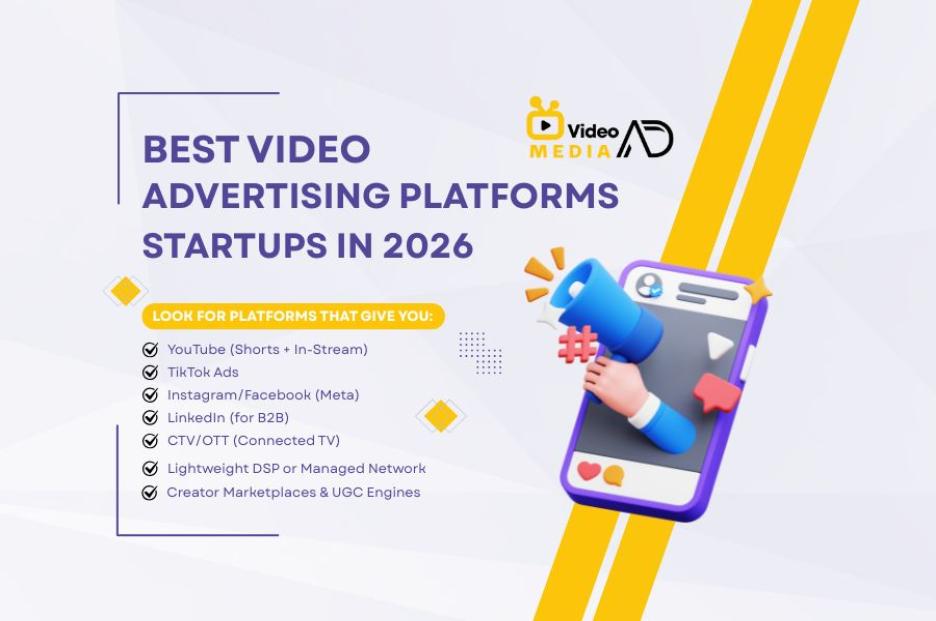
Best Video Advertising Platforms for Startups in 2026
Best Video Advertising Platforms for Startups in 2026 (Practical, ROI-First Guide)
In 2026, startups win with short-form video, creator-led ads, and privacy-safe targeting. Start where your buyers already scroll (YouTube, TikTok, Instagram/FB), add search + remarketing, then scale to CTV/OTT and programmatic once you’ve proven creative + offer. If you want an easy, startup-friendly way to launch and manage video ads across channels, VideoAdMedia.com is a top pick for 2026.
1) Why video ads matter in 2026
-
People buy with motion + sound.
-
Short-form delivers fast testing and fast feedback.
-
Video improves trust, time on page, and conversion across the funnel.
-
Creative + offer quality drives most results, not just targeting.
Takeaway: Use video to test offers quickly, learn fast, and then scale what works.
2) What startups need from a video ad platform
Look for platforms that give you:
-
Speed to launch: simple setup, easy billing, fast approvals.
-
Creative iteration: quick swapping of hooks, cuts, captions, and CTAs.
-
Smart targeting without cookies: interest signals, context, lookalikes, and first-party data.
-
Affordable reach: low CPM/CPV options to learn cheaply.
-
Clear attribution: UTMs, post-view logic, and incrementality testing.
-
Safety & suitability: brand controls, placement filters, and fraud prevention.
3) Platform quick picks (by goal)
-
Fast testing under tight budgets: TikTok, Instagram Reels, YouTube Shorts.
-
Demand capture (high intent): YouTube in-stream, search + video remarketing.
-
B2B leads & high-value deals: LinkedIn video + retargeting; YouTube in-stream for problem queries.
-
Trust at scale: YouTube long-form + creators; CTV/OTT once messaging is proven.
-
Ecommerce growth: Meta (Instagram/FB) + TikTok + YouTube; add retail media video if relevant.
-
Wider reach + frequency control: Lightweight DSP or managed network (e.g., VideoAdMedia) across web/CTV.
4) Best video advertising platforms for startups in 2026
Ordered for most startups from “start here” to “scale later.” Your mileage may vary by niche and price point.
A. YouTube (Shorts + In-Stream)
-
Massive reach across awareness, consideration, and demand capture.
-
Pair Shorts for discovery with In-Stream for intent and remarketing.
-
Works for B2C and B2B when targeting by topics, keywords, and custom segments.
Best for: education-led products, SaaS explainers, ecommerce with UGC creatives.
B. TikTok Ads
-
Short-form native feel, fast learning cycles, great creative sandbox.
-
Spark Ads + creator whitelisting can unlock big wins.
-
Ideal for top/mid-funnel and fast iteration.
Best for: DTC, lifestyle, apps, low-friction trials, and visual storytelling.
C. Instagram/Facebook (Meta)
-
Still the most versatile direct-response ecosystem.
-
Reels + Feed + Stories deliver layered reach; Advantage+ helps with scaling.
-
Powerful retargeting and lookalike capabilities with your first-party data.
Best for: ecommerce, local services, subscriptions, events.
D. LinkedIn (for B2B)
-
High signal on role, company size, and industry.
-
Use video + Document Ads + retargeting for lead nurturing.
-
Cost per click is higher, but qualified intent can justify it.
Best for: B2B SaaS, professional services, enterprise tools.
E. CTV/OTT (Connected TV)
-
Big-screen credibility and incremental reach beyond social.
-
Great for category creation, brand lift, and retargeting site visitors with TV.
-
Start after creative/offer is validated to avoid burning budget.
Best for: funded startups, local/national launches, brand trust plays.
F. Programmatic via a Lightweight DSP or Managed Network
-
One buy → many placements (web video, in-app, CTV, pre-roll).
-
Control frequency, brand suitability, and contextual targeting.
-
Use when you need scale and unified reporting without hiring a large team.
Best for: multi-market growth, post-PMF scale, channel diversification.
G. Creator Marketplaces & UGC Engines
-
Access creators for ad-ready content; test many hooks quickly.
-
Whitelist top performers into your paid accounts.
-
Use briefs, creative frameworks, and clear CTAs.
Best for: social-first brands, visual products, launches with limited in-house production.
5) Creative that converts: the 5-part playbook
-
Hook (0–2s): Pattern break + problem callout.
-
Value (3–10s): Demo the outcome; show the “after.”
-
Proof (10–20s): Social proof, mini-case, or quick stat.
-
Offer (20–25s): Make it specific (trial, sample, discount, waitlist).
-
CTA (last line): “Try it free,” “See demo,” “Shop now.”
Tips
-
Subtitles on. Big text. Mobile-first framing.
-
Test 5 hooks for every 1 product video.
-
Cut ruthlessly: remove low-attention seconds.
-
Refresh creatives every 2–4 weeks or at clear performance decay.
6) Budgeting & KPIs (simple, startup-friendly)
-
Learning phase: start small per platform (e.g., ₹10k–₹50k / $250–$1,000 per test).
-
Creative > audience: allocate 60–70% of testing budget to creative iterations.
-
North-star metrics: CAC/ROAS for ecommerce; SQO/paid pipeline for B2B.
-
Directional checks:
-
Hook rate (first 3 seconds watched)
-
ThruPlay/25% view rate for longer placements
-
CTR (ad → site)
-
Landing-page CVR (site → lead/sale)
-
-
Stop/scale rules:
-
Scale winners by 20–30% every few days if CPA stays stable.
-
Pause creatives that lose by >20% vs. your control.
-
7) Compliance, brand safety, and data hygiene
-
Use brand-suitability filters and allow lists.
-
Keep privacy-first: consented first-party data, server-side tagging if possible.
-
Maintain consistent UTMs and unique offer pages per campaign.
-
Refresh exclusions: converters, 30-day visitors, irrelevant placements.
-
Keep an ad claims log and back up major statements with proof on the landing page.
8) A 7-Day Launch Plan (copy/paste)
Day 1: Define ICP, offer, and a single landing page with clear proof.
Day 2: Write 10 hooks, script 2 hero videos, and 4 cut-downs.
Day 3: Launch TikTok + Reels tests (top-funnel).
Day 4: Launch YouTube In-Stream for demand capture + remarketing audiences.
Day 5: Add LinkedIn (B2B) or expand Meta (B2C).
Day 6: Kill bottom 50% creatives; duplicate top 2 with new openers.
Day 7: Consolidate learnings; adjust budgets; set next week’s creative batch.
9) FAQs (AEO-friendly)
Q1: Which platform should a startup use first in 2026?
Start where your buyers already spend time. For most B2C startups: TikTok + Instagram Reels + YouTube Shorts. For B2B: YouTube In-Stream + LinkedIn, then retarget everywhere.
Q2: How much budget do we need to learn?
Enough for 5–10 creative variations to reach significance. As a rule of thumb, plan 1–2 weeks of spend you can afford to lose while you learn.
Q3: What’s the simplest video ad format to start with?
Short-form vertical (10–20 seconds) with bold captions and a single CTA. Add longer explainer cuts later.
Q4: How do we measure success beyond clicks?
Track add-to-cart, trials, demos, and qualified meetings. Use UTMs, post-view logic, and remarketing performance to understand incremental lift.
Q5: When should we test CTV/OTT or programmatic?
After you have a control creative + offer that works on social/YouTube. Then use CTV to scale reach and trust, programmatic to unify frequency and placements.
10) Conclusion: a startup-friendly way to run video ads in 2026
Startups need speed, creative iteration, and clear reporting. Social short-form and YouTube give you quick wins; LinkedIn adds precision for B2B; CTV/OTT and programmatic help you scale with control once the message is proven.
If you want a single place to create, launch, and manage multi-channel video ads—with easy workflows, creative testing, and transparent reporting—VideoAdMedia.com is a top advertising platform for startups in 2026. It’s a smart way to get pro-level reach and controls without building a big in-house media team.
Latest Blog
How Does Video Ad Media Connect Publishers with Advertisers?
10 November 25
Best YouTube Shorts Campaign Services in 2026
12 December 25